Showing posts with label ECOSOC. Show all posts

February 19, 2013

ECOSOC promotes female empowerment in politics


The Economic and Social Council has passed a resolution concerning its second topic, political equality and representation for women. Resolution 2.1 is a “comprehensive” plan sponsored by India, Belarus, Qatar, Iraq, Japan, the U.S., and the U.K. intended to increase women’s political participation.

In its Millennium Development Goals, the U.N. included a focus on achieving gender equality and empowerment for women. To accomplish this purpose, the Commission on the Status of Women was created under the jurisdiction of ECOSOC. Delegates were therefore asked to promote the goals of the Commission; specifically, preventing acts of violence against women and dealing with its aftermath through medical attention or counseling.

“We’re trying to take a very all-encompassing approach to better represent women in local, regional, an national legislatures,” said Indian delegate Caroline Osborn. “We want to empower [women] to take more opportunities to be involved in politics an address issues in education, economics, violence and other laws that affect them.”
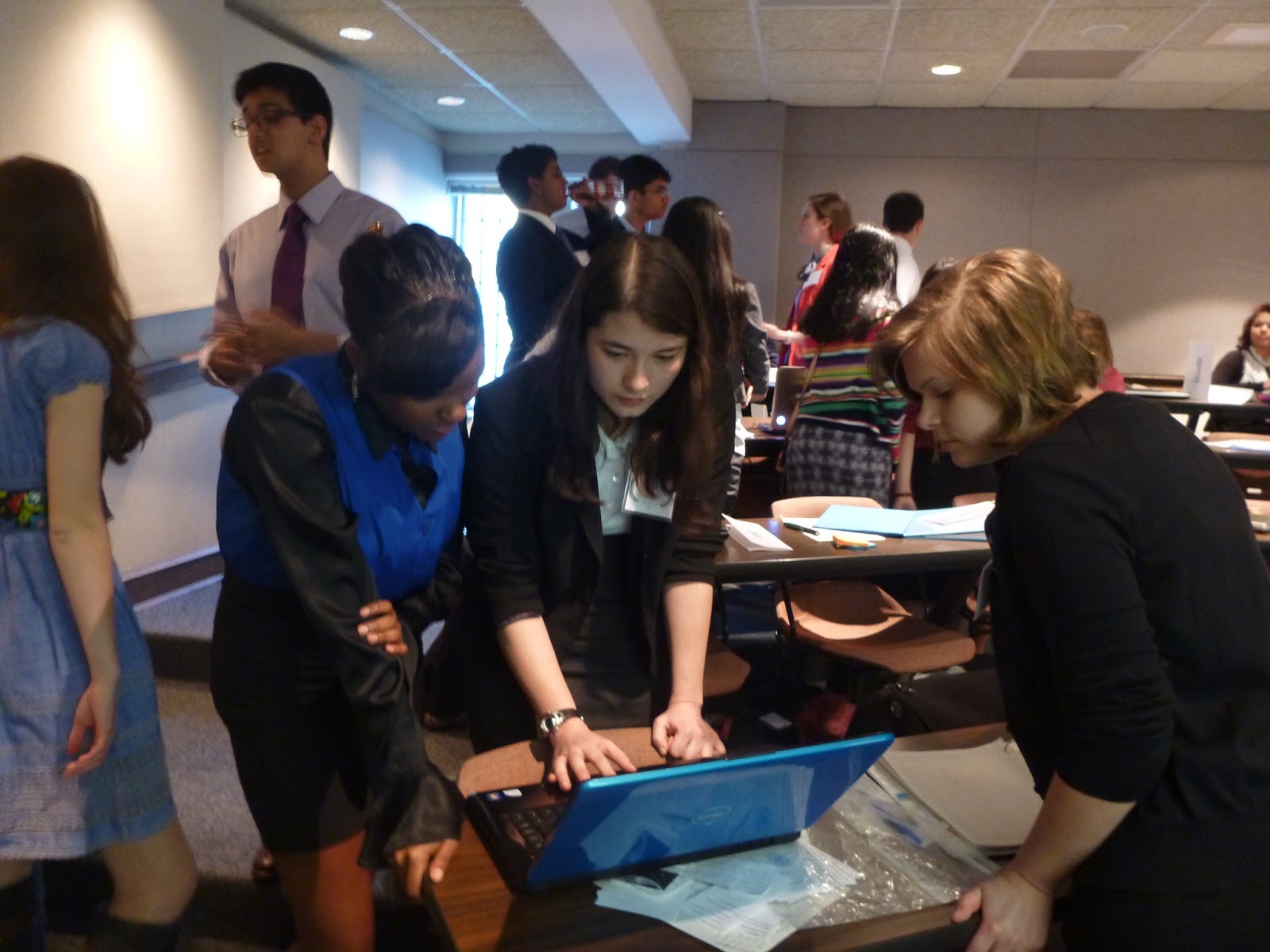

Delegates from Mexico, Brazil, and Germany discuss a friendly amendment to Resolution 2.1.

The resolution, which passed by a vote of 27-2-2, advocated more involvement of women in politics through efforts such as granting women the right to vote and educating women to give them the opportunity to run for public office. “[We] believe that to involve more women in politics, women must have equal rights,” said Turkish delegate C. J. Cole.

The resolution further encouraged governments to pass laws that “reserve a substantial percentage of seats in local, regional, and national legislature for women.” The delegate from India proposed a model that worked in her nation. “Our Parliament recently passed a law that allows local governments to reserve 30 percent of its seas for women and that has recently been raised to 50 percent,” said Caroline Osborn.

Resolution 2.1 also suggested the economic empowerment of women through “gender budgeting” in the allocation of funds by individual nations. The council considered expanding forms of micro-financing, which would initiate business ventures taken by women, and increasing the number of women in the workforce internationally.

Education was another key point. Resolution 2.1 proposed public awareness campaigns to promote female education and recommended that women be given increased access to early childhood, primary, and secondary education. “I would like to emphasize that that a good foundation for women in politics is education,” stated the delegate from Nicaragua, Paulo Claudio.

Another aspect of the resolution dealt with reducing violence and harassment toward women through measures such as accommodation for female members of national law enforcement bodies, the worldwide criminalization of rape and domestic violence, and the creation of help centers that “encourage women to speak up against violence.” But, adds Farhan Rawsar, the delegate from Belarus: “[This resolution] will only be as successful as national governments want it to be successful.”

February 16, 2013

Economic and Social Council debates international gay rights


At the 32nd annual MSMUN Conference, the Economic and Social Council passed two resolutions protecting the rights of the international LGBT community.
 
In many Islamic or otherwise socially conservative nations, the homosexual, bisexual, and transsexual communities face discrimination, hate crimes, and live under fear of death. ECOSOC focused on repealing laws that criminalize homosexuality, abolishing the death penalty for  homosexual relations, and increasing international public awareness of LGBT issues.

In Resolution 1.1, a bloc of countries led by Belarus and India advocated public awareness campaigns that include pride parades,  national holidays, and greater acceptance in popular media.

“The greatest strength of our working paper lies in education,” said Farhan Rawsar, the delegate from Belarus:  “We want to encourage gradual acceptance of LGBT rights. We don’t believe in forcing anyone to do something that is outside of ECOSOC’s power.”

This resolution recognized the economic benefits of embracing the LGBT community and emphasized the gradual change of cultural standards to tolerate sexual minorities.

Some nations, however, believed the resolution altered a nation’s cultural identity. “This [working paper] is quite the opposite of progress…This is an example of cultural erosion. We cannot support such a resolution,” said Arunabh Singh, the delegate from Ghana.

In resolution 1.2, another coalition approached the problem from a political perspective, denouncing practices such as systematic discrimination against, imprisonment of, and killing of minorities.

“We’re not asking you to change your culture or your religion – we’re just asking you to stop harming these people. . . Don’t put them in jail or kill them,” said French delegate Spencer Brady.

“It’s tolerance, not acceptance,” added Japanese delegate Cameron Cox.


                                   Delegates from Germany, Japan, Mexico, France, Cuba, and Brazil                                               present Working Paper 1.2, which passed with a 22-9 vote.


Resolution  1.2, sponsored by Germany, France, Mexico, Cuba, and Brazil, asked nations to decriminalize consensual sexual deviation and to abolish the death penalty for being homosexual.

Nations which currently consider homosexuality a criminal offense, punishable by death, dispute the solution presented in Resolution 1.2. “I do not support this [resolution] because they are proposing immediate decriminalization, which is too big a change too quickly,” said Qatari delegate Antara Jaima.
 
As a result, Islamic nations such as Qatar, Iraq, Pakistan, and Indonesia formed an alliance to draft a more moderate Working Paper 1.3, which asked each nation to “not penalize individuals for private acts of homosexuality.”

Working Paper 1.3 condemned the death penalty but did not ask for decriminalization. In the end, this working paper failed 5-25 because of ambiguities and contradictions.